"I knew you were smart! And they can't extradite you because there is no extradition treaty between France and China!" — When a U.S. Intelligence Operative in China Blew His Cover
⚠️ This is a national-security-related event.
First published on this website on April 30, 2026.
Disclaimer. English is not my native language. I can express myself relatively well in English, but I prefer to use AI to help me polish my explanations, which can sometimes be tricky for various reasons. Today is 30 April 2026, the day I will attempt to publish this page for the first time. It has been more than two weeks since I missed the summons I received from French investigative judge Isaac Parrondo, who apparently took over the investigation from judge Pascal Latournald. I am therefore in a hurry to publish this page. I will not have time to reread it carefully, and it may contain errors. I have, however, gone over the AI-assisted draft quickly and have had to correct multiple approximations the AI introduced. When I have time, I intend to read this page carefully and slowly, try my best to recall additional details, and add indirect evidence supporting what I am stating about this event.
On the evening of 23 August 2019, my wife and I hosted Subjects #2 and #3 for dinner at our home in Taiyuan, Shanxi Province. The residence was located inside the Shanxi Provincial CPPCC Committee Organ Apartment (山西省政协机关公寓), in a second unit belonging to my parents-in-law. Subjects #2 and #3 are the same persons identified, by their numbered designations, in my complaint to the United States Department of Defense Office of the Inspector General (DoD OIG).
Summary
Subjects #2 and #3 are U.S. intelligence operatives. I did not know that on the evening of 23 August 2019. My wife had voiced her own suspicion to that effect after our first encounter with them (see First encounter with American spies (then only a mere suspicion, but now confirmed); the date in that earlier entry is approximate), but I did not share her assessment at the time. The events of that evening would later prove to have a significant impact on the broader case, because Subject #2 made a remark over dinner that, in retrospect, blew his cover. I only came to understand this later. The remark, and the reasons it can only be read in that way, are set out below.
The date
The date is fixed by two corroborating sources I retain: a calendar reminder I set for 16:30 on 23 August 2019 to chill a bottle of wine, and a WeChat message I sent to Subject #3 the following day, 24 August 2019 at 12:14, thanking her and Subject #2 for coming over for dinner the evening before.
Context preceding the dinner
By August 2019, my wife and I had grown to consider Subjects #2 and #3 friends. We had been to their home at least once or twice, possibly more. The dinner of 23 August 2019 was, if and only if I recall correctly, the second or third time they came to our home. If I am wrong on that count, it was the first.
If and only if I recall correctly (I can double-check this later by reviewing the WeChat history), at some point in the period preceding the dinner (not the same day), over WeChat, I told Subjects #2 and #3 that I was pursuing a legal case against a major American corporation, without identifying which one. If and only if I recall correctly, Subject #3 indicated they would be interested in hearing about it.
The discussion
The evening was, if and only if I recall correctly, the first occasion on which I walked Subjects #2 and #3 through the substance of the McDonald’s promotional fraud case in any detail. Subject #2 stated that he was personally familiar with sweepstakes mechanics, having participated in such promotions himself. The way he framed it, he came close to self-presenting as an expert. I remember thinking, in the moment, that I felt blessed: a friend of mine apparently knew sweepstakes well, and I could explain everything to him. I did.
Side note added with the benefit of hindsight (29 April 2026). I am writing this entry today, on 29 April 2026, well after the events of 14 July 2023 in Taiyuan, when Subject #2 acknowledged in person that he was U.S. intelligence (in indirect register, characteristic of tradecraft). With that hindsight, I want to flag for the reader an alternative reading of the moment described above. It is true that Subject #2 demonstrated knowledge of sweepstakes mechanics that evening, including familiarity with the AMOE regulations. But it is also possible that he was not the self-proclaimed sweepstakes participant he presented himself as, and that he in fact already knew everything about my case before walking into our home. On that reading, his intent in encouraging me to explain the case in detail was not curiosity but assessment — testing me and the soundness of my reasoning. I cannot prove this alternative reading. I record it here so that the reader has both possibilities in front of them.
The conversation included a kind of brainstorm on the French version of the McDonald’s promotion advertised as “1 chance sur 4” (translated: 1 chance out of 4 to win instantly). If and only if I recall correctly, the four of us were trying to understand and figure out McDonald’s claim that consumers in France had a one-in-four chance of winning instantly, in a structure where one attempt corresponded to one game stamp.
Note for the reader on the probability-understanding evolution. As of 23 August 2019, my understanding of the precise mathematical structure of the McDonald’s promotional fraud was still in formation. There were periods during which I doubted myself and wondered whether I was missing something, and periods during which an external acknowledgment from someone competent helped me regain confidence that my analysis was on the right track. I had not yet worked through the binomial-distribution and hypergeometric-distribution analyses that would later allow me to state the fraud structurally. I plan to publish a separate dedicated page tracing the evolution of my understanding from July 2019 through 2023, with links to the contemporaneous documents that mark each step, including the role of certain external acknowledgments and the subsequent pressures associated with some of them. That separate page is not yet written; it will be linked from here when it is.
At some point during dinner, I went to fetch my laptop and brought it back to the dining table to show them some of the evidence.
The conversation also covered the United States version of the McDonald’s promotional structure. I explained that a McDonald’s disclaimer used in the United States, to the effect that a purchase did not increase the chances of winning, was false. My reasoning was that if a participant were able to purchase the entire stock of game stamps, that participant would be 100% certain to win. Practically difficult, but logically sufficient to demonstrate that the disclaimer was false. Subject #2 refined the point in real time, adding in substance: “[and would also obtain all of the stickers available through the alternative method of entry (AMOE)]”. I agreed: “[yes, and this]”. The exchange showed that he had grasped the structural defect of that specific U.S. disclaimer thoroughly.
The complete corollary — that the disclaimer can only be literally true if every participant always wins or every participant always loses — I only formalised to myself later, around the end of 2022 or the beginning of 2023, when I was working closely with the binomial distribution formulas. (If and only if I am not mistaken on the period. I could try to pin the date more precisely later if I find the time, against my notes from that period.)
Throughout the discussion, Subject #2 challenged my reasoning forcefully. I remember thinking, internally and at the time: “[wow, are you my friend? Why are you pushing back this hard?]”. The thought was not animosity. I considered him a friend. It was a half-joking, half-serious wondering at the persistence of his pushback, which felt as though he were trying to find a flaw in my reasoning and was not finding one. The thought is recalled in substance, not verbatim. The square-bracket convention used in this entry marks near-verbatim recollection rather than certified quotation.
The extradition remark: the forensic core of this entry
At a point during the conversation, Subject #2 said, in substance and very close to verbatim by my recollection:
“[I knew you were smart! And they can’t extradite you because there is no extradition treaty between France and China!]”
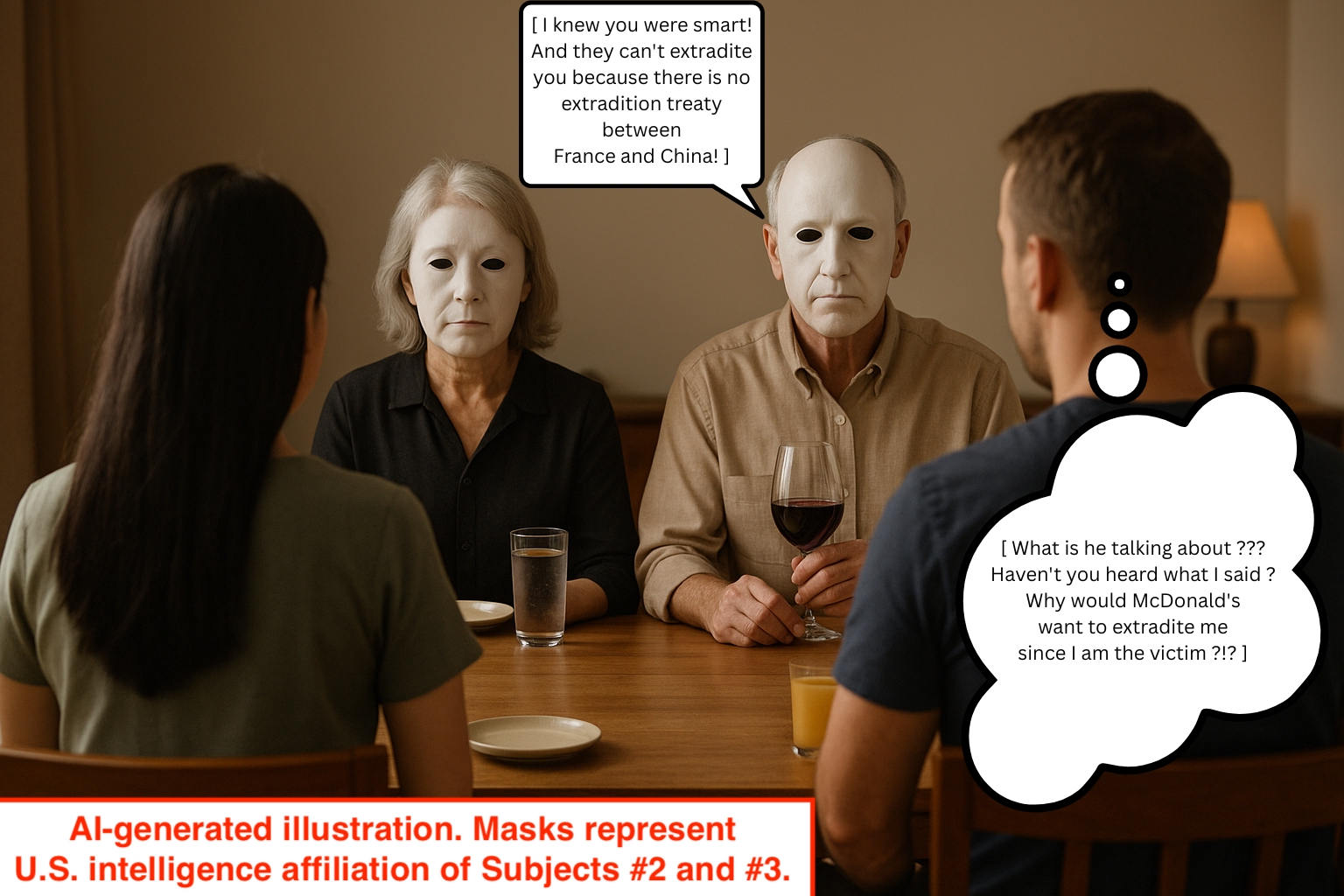
The remark was accompanied by a slight chuckle. My internal reaction at the moment, in substance: “[what is he talking about? Why would McDonald’s want to extradite me, since I am the victim?]”. As far as I can recall, I did not respond aloud and the conversation moved on. I registered confusion but did not pursue it.
The asymmetry of the remark, in retrospect
A friend listening to a victim describe a fraud case would have no occasion to remark on extradition. The remark presupposes the existence of a party with standing to seek the extradition of the speaker’s interlocutor, and a jurisdictional analysis of why such an extradition would fail. Neither presupposition fits the conversational context as I had presented it. I was the complainant, not the target of any proceeding. I was not, to my own knowledge, a wanted man. I would only later come to understand that my situation as a target had been operationally legible to others before it was legible to me.
A contemporaneous trace. Some time after the dinner, I sent an email to Subject #2, with Subject #3 and my wife in copy, sincerely asking my friend how he could have known what he had said. The email is documented here: Email to U.S. intelligence “friends” — McDonald’s extradition (August 2019). The title of the linked entry uses present-day terminology; on the evening of 23 August 2019 and at the time of the email, I did not yet identify Subjects #2 and #3 as intelligence operatives.
Drinking dynamics
I had bought a bottle of wine specifically for Subject #2, who was the only person consuming alcohol that evening. I was on a personal break from alcohol. Subject #3 brought non-alcoholic sparkling wine. (I did not initially recall this detail. I inferred it later, when I went back through my contemporaneous WeChat messages around the date in order to fix the dinner’s exact date.)
Subject #2 consumed, I estimate, approximately 20 to 30 centilitres of a 75-centilitre bottle. As I walked the guests out to the gate of the compound at the end of the evening, Subject #2 was visibly cheerful and said, with notable warmth, “thank you Sir.” It was the most overtly cheerful I ever observed Subject #2 to be.
Retrospective re-reading
On the evening of 23 August 2019, I had no operational basis to suspect that Subjects #2 and #3 were anything other than American Christian missionaries, who had become our friends, in Taiyuan. The frame in which the extradition remark would become legible was not yet in place. Two later developments are central to that re-reading:
-
My wife had, prior to August 2019, voiced her own suspicion that Subjects #2 and #3 might be U.S. intelligence (see First encounter with American spies (then only a mere suspicion, but now confirmed); the date in that earlier entry is approximate). I considered her assessment unlikely at the time.
-
On 14 July 2023, in Taiyuan, Subject #2 acknowledged the affiliation in person. The acknowledgment was not in plain language; it followed the indirect register characteristic of intelligence tradecraft, sufficient for me to register it while preserving plausible deniability for the speaker. That meeting will be the subject of its own timeline entry.
My present-day identification of Subjects #2 and #3 as U.S. intelligence operatives is formally asserted in my complaint to the DoD OIG.
Why this entry matters
The extradition remark of 23 August 2019 is contemporaneous evidence that the speaker possessed information about my situation that was not accessible to an ordinary friend who had just been briefed for the first time on the fraud case I was pursuing. The remark is a single sentence. In the light of what came later, it marks the earliest moment I am presently aware of when a foreign intelligence service indirectly revealed that I was being treated as a target.