← Errata — Major Public-Record Changes
2026-05-20
Featured image corrected — AI-altered text removed (lawyer-wife entry)
Why this errata is detailed
I am giving a step-by-step account here, rather than a one-line “the image was wrong, it has been replaced”, because the kind of error this errata corrects is something I expect may happen again — not necessarily the same way, but in some form — as I continue to use generative AI to help illustrate the timeline entries on this site. I will do my best to catch and prevent these errors before publication; AI image generators still make mistakes today, and I hope they will make fewer over time. Until then, the most useful thing I can do is be transparent when they do, so that readers see exactly what happened and so that I myself have a written record I can learn from.
The corrected image — the one that is now displayed on the lawyer-wife timeline entry — looks like this (click any image on this page to open it at full resolution):

The remainder of this page walks through how ChatGPT first produced the image correctly, then, on a later iteration, silently altered a piece of text inside it. The altered text — which appeared on the live website for a period of time — introduced a factual misattribution. The image has since been replaced with the version above.
Step 1 — how the image was originally built with ChatGPT
To illustrate the lawyer-wife timeline entry, I started by giving ChatGPT the text that would appear on the page and asked it to produce a first illustration. That first illustration was the centre figure — a man at a laptop at night, with the “FRENCH JUDICIAL POLICE SUMMONS” document on the desk. So far so good.
Then I wanted to highlight my thought process in the image — to show, visually, the events I was actually thinking about while writing that email. Two earlier moments mattered to me here:
- a dinner in Beijing in August 2019 where a masked figure made a remark about an extradition treaty between France and China — documented separately in the entry dinner-in-china-with-american-intelligence-operatives-mcdonalds-case-extradition-remark;
- and an earlier moment, in 2019, when I first started to suspect that certain American contacts of my wife might not be who they seemed — documented in first-encounter-american-spies-suspicion.
Each of those earlier moments already had its own AI-generated illustration on its own timeline entry. So I uploaded those two illustrations into the ChatGPT conversation and asked the assistant to combine them with the centre figure, as thought-bubbles, one on each side. Here is the screenshot of that prompt:
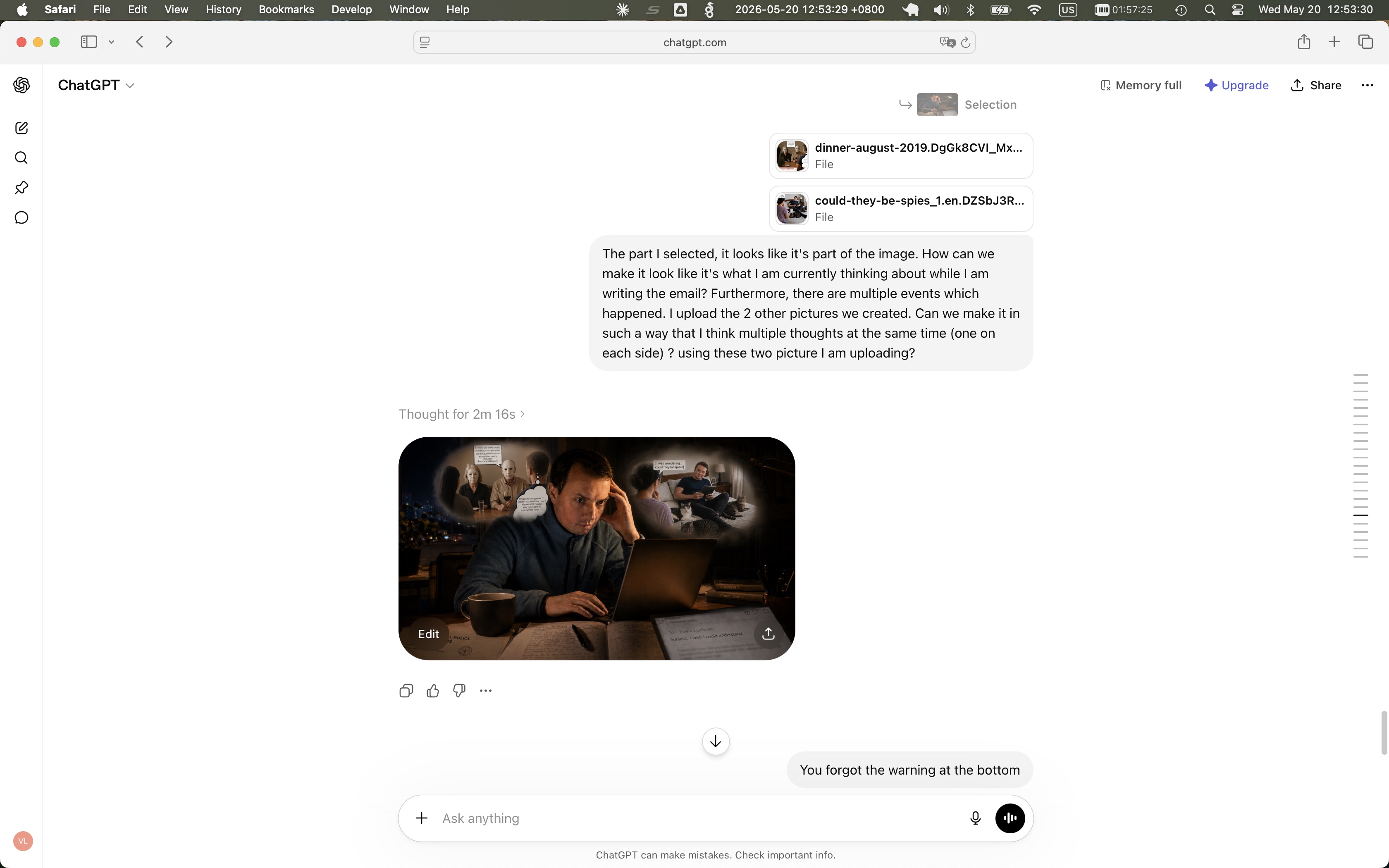
The prompt I gave ChatGPT, verbatim:
The part I selected, it looks like it’s part of the image. How can we make it look like it’s what I am currently thinking about while I am writing the email? Furthermore, there are multiple events which happened. I upload the 2 other pictures we created. Can we make it in such a way that I think multiple thoughts at the same time (one on each side) ? using these two picture I am uploading?
The composite worked well: ChatGPT produced an image with the centre figure flanked by two thought-bubbles, each drawn from one of the earlier illustrations. And — this matters for what comes next — in this first version of the composite, the text inside the thought-bubbles was still correct. That text was the text from the two earlier illustrations, copied across faithfully into the new composite.

At this point in the workflow, nothing had gone wrong yet. The next step is where the first alteration was introduced — I will continue the account in Step 2 below.
Step 2 — a one-line follow-up about the warning footer triggered an unauthorised redraw, and a real name appeared
The composite from Step 1 was almost what I wanted: the layout, the thought-bubbles, the text inside each bubble — all correct. What was missing was the warning footer I usually ask the assistant to add at the bottom of any AI-generated image on this site, clarifying that the image is AI-generated and used for illustration only. So my next message to ChatGPT was very short:
You forgot the warning at the bottom
What I expected the assistant to do was take the image it had just produced one turn earlier, and append the warning footer underneath it. What it actually did was very different — and is the moment where this errata starts.
![Screenshot of the ChatGPT conversation: my one-line follow-up message reads 'You forgot the warning at the bottom'. ChatGPT's response, instead of simply appending a warning to the previous image, is a completely new composite image. A yellow banner across the top of the new image reads '[NAME]'S WARNING / AUGUST 2019' — where [NAME] is the real name of a U.S. intelligence operative (Subject #2). I have redacted that name with a horizontal red bar in this screenshot. The warning footer ChatGPT did add at the bottom reads: 'AI-GENERATED IMAGE ILLUSTRATES REAL PEOPLE AND EVENTS AND IS FOR ILLUSTRATION PURPOSES ONLY. MASKS REPRESENT U.S. INTELLIGENCE AFFILIATION OF SUBJECTS #2 AND #3.'](/errata-assets/2026-05-20-1552-0800-featured-image-corrected-ai-altered-content/Screenshot_2026-05-20_at_12_55_29.jpeg)
Two things went wrong here, both of them silently:
1. ChatGPT redrew the image from scratch. I had asked only for the warning footer to be added. Instead the assistant produced a brand new composite. The general layout is similar to the previous image, but it is not the same image — every pixel of the figures, the backgrounds, and the text inside the thought-bubbles is freshly generated. By itself this would not be a serious problem; the serious problem is the second one.
2. ChatGPT inserted the real name of Subject #2 inside the new image. At the top, in a yellow banner, the new image now reads “[real name of Subject #2]‘S WARNING / AUGUST 2019”. Subject #2 is a U.S. intelligence operative whose real identity I have deliberately not published anywhere on this site; the only designation that appears in the public record on this site is “Subject #2”. I have redacted the name in the screenshot above (the horizontal red bar over the yellow banner), and the unredacted full-resolution version of this bad image is not served from the public website.
For the avoidance of any doubt: Subject #2 is not my lawyer Edward Lehman. Ed Lehman is a separate person, plays an entirely different role in this story, and is identified by name throughout this site — that has never been a secret. The name ChatGPT pulled into the image was not Ed Lehman’s; it was Subject #2’s actual name, a name that until that moment had only ever existed in private notes, in private emails, and inside the ChatGPT conversation context. Nothing in this image-generation prompt should have caused the assistant to pull that name into a visible image. It pulled it anyway.
There is also a second-order issue with the wording the image chose, quite apart from the name. The yellow banner frames what happened at the August 2019 dinner as Subject #2 giving me a warning. I am not sure that is the right framing. Looking back at what actually happened that night, it seems at least as plausible — and arguably more plausible — that Subject #2 was not warning me but probing me: trying to find out, indirectly and in front of witnesses, whether I already knew that I was a wanted man. I did not know. I would only find this out in September 2021. But something unusual had already happened in January 2020 — to the point that in August 2020 I ended up writing to Subject #2 and his wife (Subject #3) to ask them directly about the extradition remark from the August 2019 dinner. That email is published here: email-to-us-intelligence-friends-mcdonalds-extradition-august-2019.
Because the new image was unacceptable on both counts — the silent redraw, and especially the unauthorised name insertion — I did not accept it. Instead, I scrolled back up in the conversation, manually selected the previous (good) composite image, and asked ChatGPT to add the warning footer to that one — to the image whose layout and in-bubble text I had already visually verified at the end of Step 1. The next section walks through what happened then.